Recruitment agency questions: What employers should ask before signing a contract

Choosing the right recruitment agency can make or break your hiring outcomes. The right partner helps you save time, reduce turnover, and improve cultural fit by streamlining your hiring process. Across markets where competition for talent remains high, finding candidates through a partnership with a strong recruitment agency can directly influence business growth, team performance, and retention success.
Before signing a contract with any recruitment company, it’s essential to look beyond sales pitches and ask the right questions. Doing so ensures transparency, protects your hiring investment, and sets the foundation for long-term collaboration – because choosing the wrong partner can lead to costly mistakes.
This article outlines the key questions employers and human resource (HR) leaders should ask before choosing a recruitment partner. It explains how to evaluate expertise, methodology, and candidate quality while ensuring alignment on culture, transparency, and data responsibility. You’ll also learn how to identify red flags and apply a practical checklist to assess potential partners with confidence.
Whether you’re hiring for one critical position or building long-term workforce capability, these insights will help you select a recruiting agency that not only fills roles efficiently but also strengthens your organisation’s talent strategy and employer brand.
You’ll learn how to
Click any of the links above to jump to a specific section in this article.
Recruitment agencies differ widely in their specialisations, methods, and outcomes. While many promise access to “top talent”, the real differentiator lies in how they deliver results.
Asking the right questions reveals not just the agency’s recruitment process, but also its reliability, communication style, and alignment with your organisation’s values. These discussions demonstrate how they can support your entire hiring process from start to finish.
In markets where hiring speed can make a competitive difference, it’s equally useful to understand how a partner can help reduce hiring time while securing top talent. This starts with knowing the recruitment agency’s processes before forming a partnership.
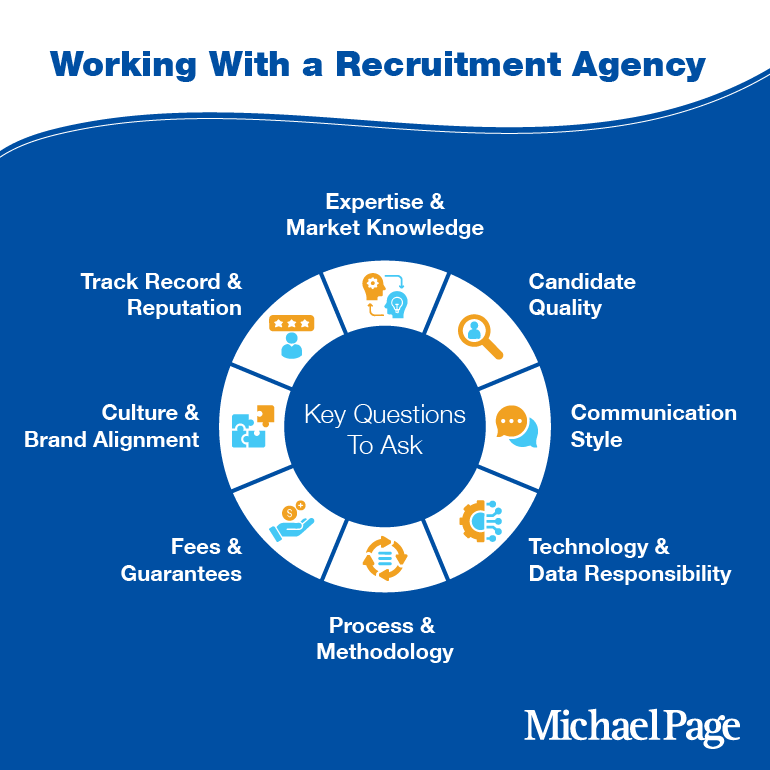
Your first step is to confirm whether the agency genuinely understands your hiring needs.
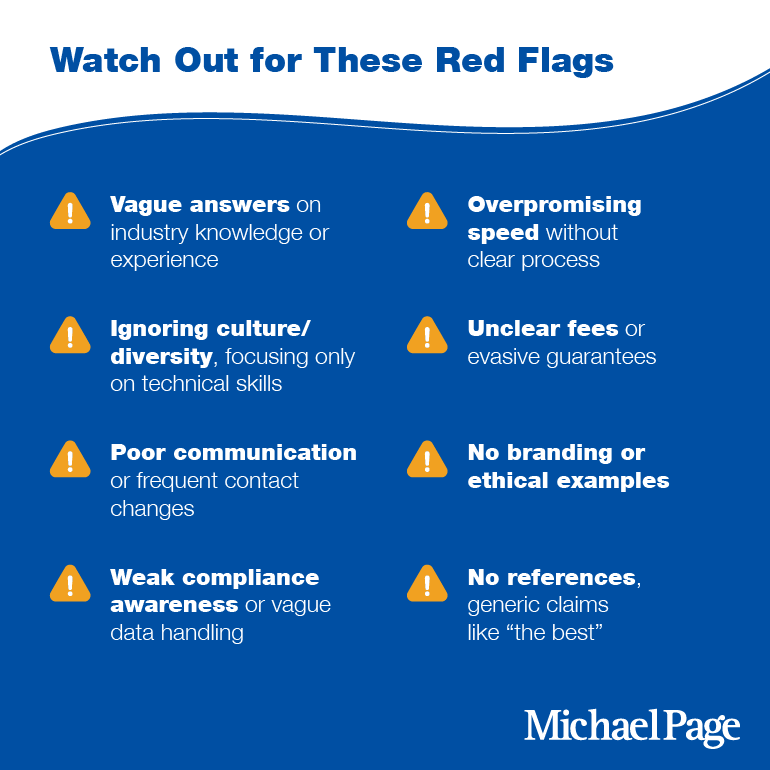
Red flag: Vague answers about your industry or a lack of proven experience in your market.
Almost all top recruitment agencies claim to have a proven hiring process, but the details matter.
Agencies that can explain their methodology clearly tend to have refined, data-informed processes.
Red flag: Overpromising speed without clear methodology.
A recruitment agency’s credibility depends on its ability to source, screen, and present the right talent.
Red flag: Agencies that focus only on technical skills without addressing culture or diversity.
Clarity around costs protects your budget and builds trust.
A clear discussion about pricing helps employers evaluate total return on investment. Understanding the real costs of hiring also helps you benchmark agency fees against the value they deliver.
Red flag: Evasive or unclear answers about fees and guarantees.
A strong recruitment relationship is built on communication.
Red flag: Lack of a clear communication structure or frequent point-of-contact changes.
Recruiters represent your company to the market, so alignment is key.
Red flag: No concrete examples of employer branding support or ethical practices.
Modern recruitment services use data and tech, but it must be handled responsibly.
Red flag: Lack of awareness around local compliance or vague answers on data handling.
Finally, validate the agency’s credibility before committing.
Red flag: Unwillingness to provide references or generic claims about being “the best.”
Many recruitment agencies claim to build partnerships founded on trust, transparency, and shared ambition – but only the ones who deliver on these values are the most effective. Employers, HR leaders and hiring managers who ask the right questions – and listen closely to how agencies respond – can identify partners who truly understand their business objectives and hiring needs.
Beyond filling roles quickly, the right recruitment partner contributes to your organisation’s broader talent and hiring strategy, helping you attract, engage, and retain the right people over time.
By recognising red flags early and using the checklist above, you can confidently choose a partner who drives both immediate results and long-term workforce success.
Ready to hire? We specialise in a variety of sectors and are ready to discuss your vacancy. Contact us and we’ll find the right consultant for your location and role.
If you are an employer and would like to discuss your hiring needs, fill in the form below and we will call you back.
 沪公网安备 31010602006645号 © Michael Page (Shanghai) Recruitment Co., Ltd. (Company No. 310000400583735) is part of the PageGroup. Registered Office: 18/F, HKRI Centre Two, 288 Shimen Road (No. 1), Shanghai, China 200041 Page Contracting (Shanghai) Co., Ltd. (Company No. 91310106MA1FYB2513) is part of the PageGroup. Registered Office: Room 1801-1802, HKRI Centre Two,288 Shimen Road (No.1), Shanghai, China 200041. All permanent jobs are posted or shall be deemed to have been posted by Michael Page and all temporary/contracting jobs are posted or shall be deemed to have been posted by Page Contracting.